
I got an unexpected crash course in negotiating a few years ago, when I was given a seemingly straightforward project to steer.
At the time, the business was concerned with the service they were getting from the IT department. Feeds were frequently delivered late, or were missing important information when they arrived.
The business proposed the creation Service Level Agreements (SLAs) between the business and the IT team. IT was uncomfortable with this straight off the bat. They felt that the SLAs would be tilted heavily in favour of the business; they would have little influence over them. They were concerned that they might be punished unfairly for non-compliance with the terms of the agreements.
This was already looking tricky. Good relationships have to be built on trust. To bridge the gap between them, I needed to know where each party stood at the outset.
What were the opening positions of each party?
The business needed to have reliable metrics in order to escalate issues to senior management within the bank when service fell below agreed upon thresholds. It was up to IT to improve their performance in this regard.
IT felt that they had limited resources as it was to do the job that they were mandated to do. It was up to the Business to more clearly define what they meant by an acceptable level of service before trying to track and measure results. Only then would they feel in a position to start discussions. Until then, IT did not even have time to engage in discussions to arrive at SLAs.
Knowing each party’s initial position was a start. But we needed to know – what was really important to each side…
What were the underlying interests of each party?
The interests of the business seemed straightforward. They needed to have data delivered to them in a timely manner, and to know that if there are issues, that IT would work to rectify them.
If this didn’t happen, the business needed to have a clearly defined escalation process in place to deal with issues that arose.
For their part IT were to have a clear idea of what successful service delivery looks like to the business. It was very important that they be able to highlight those areas where late delivery was a result of circumstances beyond their control.
Clearly both sides had a need to get to the root cause of issues. Only by really getting to the heart of the matter could persistent problems be properly addressed.
Many of the issues that had been attributed to the IT group were in fact stemming from other areas. But IT had simply not been articulating these circumstances very well.
Once such issues were identified and understood by both sides, both IT and the business could push for a resolution as partners.
What were the impediments to getting an agreement?
The business wanted the SLAs to be binding agreements. IT had a “Best Efforts” approach in mind given their resource constraints. These contrasting positions were difficult to reconcile.
IT still felt that they would be blamed for late delivery when it was due to circumstances beyond their control, such as issues with other groups where they had a dependency. The IT group also felt that some service delivery levels that were being suggested for the SLAs were too difficult for them to attain.
A surprising sticking point for the IT Group was the very term “Service Level Agreement.” They wanted the agreements called “Service Expectation Agreements.” This was to emphasize their “Best Efforts” approach, rather than being subject to a strictly enforceable binding contract. This was agreed to by the business, when they understood it was important to IT and would increase their commitment to any final agreement.
What ultimately led to an agreement?
By engaging in open and frank dialogue, both sides discovered that they were just as frustrated by the current state of affairs. The business started to see things from IT’s point of view. The business had complained of poor service delivery, but now saw that IT felt they had discharged their duties as expected. Once IT saw that they had more in common with the business than they had realized they got onboard very quickly.
Why did the negotiations succeed?
What both sides needed was clarity as to what constituted poor service delivery, and to understand the reasons behind the perceived “poor” service. Crucially there had been no metrics to prove that IT was doing indeed their job. An SLA – with clearly stated service delivery targets – would be very much in everyone’s interest.
Regular meetings and dashboards with issues and root cause analysis would create a forum where problems could be brought to management from both groups, and action could be taken by consensus.
The business undertook to clearly document service delivery levels very clearly, to highlight the reasons for any issues and to seek to rectify them without pointing fingers at the IT department.
In time the SLAs proved their worth. IT saw the benefit of being able to accurately measure their performance against expectations, and the transparency that the new approach brought top problem solving.
What I learned
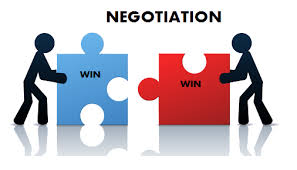
If approaching negotiations with an open and understanding mind, respect for the other party and a willingness to trust them a good outcome is possible for both sides. Truly good negotiations aren’t zero sum games. If I gain from a negotiation, it doesn’t mean you have to lose.
Whether you are involved in a negotiation as a stakeholder or as a mediator, the key to success is to understand what each side really wants. Yes, you need to ask yourself what it is you really want to get out of the negotiation as well. If you know that, and what the person on the other side of the table needs to get to come away from the process happy, then you are on your way to a successful negotiation. But as with all good things in life, it takes a lot of work
 Tom Cremins